
Aqueaous Rheological Additives Market Insights
Aqueous rheological additives market is anticipated to expand at a CAGR of 5.4% from 2025 to 2033, reaching a value of 4,187.1 million by the end of 2033.
The aqueous rheological additives market plays a critical role in enhancing the performance, stability, and application properties of water-based formulations across a wide range of industries. These additives are specifically designed to control viscosity, improve flow behavior, and ensure uniform dispersion of particles in aqueous systems. As industries increasingly shift toward environmentally friendly and low-VOC solutions, aqueous systems have gained prominence, driving the demand for efficient rheology modifiers. These additives are widely used in paints and coatings, adhesives, personal care products, construction materials, and other applications where precise control of texture and consistency is essential.
A key factor influencing the growth of this market is the rising emphasis on sustainability and regulatory compliance. Water-based formulations are preferred over solvent-based alternatives due to their reduced environmental impact and improved safety profiles. Aqueous rheological additives contribute to this transition by enabling manufacturers to maintain product performance while meeting stringent environmental standards. Additionally, advancements in formulation technologies have led to the development of more versatile and efficient additives that offer improved thickening efficiency, stability under varying conditions, and compatibility with complex systems.
The market is also shaped by evolving end-user requirements and innovation in material science. Industries are seeking additives that not only provide rheological control but also enhance properties such as durability, spreadability, and shelf stability. This has encouraged continuous research and development focused on multifunctional additives that can meet diverse performance criteria. As demand for high-performance, eco-friendly products continues to grow, aqueous rheological additives are expected to remain a vital component in modern formulation strategies across multiple sectors.
Aqueous Rheological Additives Market Composition
The composition of the aqueous rheological additives market is defined by a diverse range of product types, chemistries, and functional mechanisms tailored to specific formulation needs. These additives are broadly categorized based on their chemical nature, including synthetic polymers, natural derivatives, and associative thickeners. Synthetic variants, such as acrylic-based and polyurethane-based additives, are widely utilized due to their consistency, tunable performance, and compatibility with complex formulations. Natural and bio-based rheology modifiers, derived from cellulose, starch, or other plant-based sources, are also gaining traction as industries move toward sustainable and biodegradable solutions. Each category offers distinct advantages in terms of viscosity control, shear response, and stability, allowing manufacturers to select additives that best suit their formulation requirements.
From an application standpoint, the market composition is influenced by varying performance demands across end-use industries. In paints and coatings, rheological additives are formulated to provide sag resistance, leveling, and film uniformity, while in personal care and cosmetics, they contribute to texture, spreadability, and sensory appeal. The construction sector relies on these additives to improve workability and consistency in cementitious and mortar systems, whereas adhesives and sealants benefit from enhanced flow control and stability. Additionally, the market includes both liquid and powder forms of additives, offering flexibility in processing and formulation. This diverse composition reflects the need for highly specialized solutions that can address specific functional and environmental requirements across a broad spectrum of aqueous systems.
Aqueous Rheological Additives Market, By Type Analysis
The aqueous rheological additives market, segmented by type, encompasses a diverse range of products that enhance the flow and stability characteristics of water-based formulations. These additives are primarily classified into categories such as cellulosic derivatives, associative thickeners, and inorganic additives, each catering to specific industrial needs. Cellulosic derivatives, including hydroxyethyl cellulose (HEC) and carboxymethyl cellulose (CMC), are widely used due to their superior thickening properties, cost-effectiveness, and compatibility with a wide variety of water-based systems. Associative thickeners, on the other hand, are polymer-based additives that offer excellent rheological control and contribute to improved application performance, such as enhanced leveling, suspension of solids, and reduced sagging in paints and coatings. Inorganic additives, though less common, are valued for their ability to impart specific functional properties like thermal stability or viscosity modification in challenging processing environments. The analysis by type provides critical insights into which additive segments are driving market growth and which applications benefit most from their unique characteristics.
Within the market, the dominance of cellulosic derivatives can be attributed to their versatility and the growing demand for eco-friendly and sustainable solutions in industries such as paints, coatings, adhesives, and personal care. These additives not only improve the flow behavior of aqueous systems but also contribute to the consistency, smoothness, and stability of final formulations. Associative thickeners are gaining traction in high-performance applications, particularly in architectural coatings, industrial paints, and specialty adhesives, where precise control over rheology is essential. Their ability to provide shear-thinning behavior allows for easier application while maintaining stability during storage, making them a preferred choice for formulators seeking performance optimization. Additionally, innovations in chemical modification and polymer engineering have expanded the functional scope of these additives, enabling customized performance tailored to specific industrial requirements.
The inorganic segment, although smaller in market share, remains significant in niche applications where unique rheological characteristics are required. These additives, such as clays, silicates, and modified minerals, are often used in specialized formulations requiring high-temperature resistance, enhanced suspension of pigments, or extreme viscosity control. As industries increasingly focus on functional performance and sustainability, the integration of hybrid formulations combining organic and inorganic additives is emerging as a key trend. By analyzing the market by type, stakeholders gain a deeper understanding of consumer preferences, technological advancements, and competitive dynamics, allowing them to make informed strategic decisions. Furthermore, this segmentation highlights opportunities for innovation and product differentiation, as manufacturers strive to meet evolving regulatory requirements and application-specific demands across diverse sectors.
Aqueous Rheological Additives Market, By Application Analysis
The application-based analysis of the aqueous rheological additives market provides a deep understanding of how these products are utilized across various industries and the specific performance benefits they deliver. Rheological additives are essential in modifying the flow, viscosity, and stability of water-based formulations, and their applications span sectors such as paints and coatings, adhesives and sealants, personal care, construction, and industrial fluids. In the paints and coatings segment, these additives improve brushability, leveling, and sag resistance, ensuring a smooth and uniform finish while maintaining pigment suspension during storage. The increasing demand for waterborne coatings, driven by environmental regulations and the shift away from solvent-based products, has significantly boosted the adoption of aqueous rheological additives in this sector, making it one of the largest and fastest-growing application areas.
In adhesives, sealants, and construction materials, aqueous rheological additives enhance workability, prevent phase separation, and provide thixotropic properties that facilitate application and reduce material waste. For instance, in tile adhesives, mortars, and sealants, these additives improve spreadability and adhesion while ensuring consistent performance under varying temperature and humidity conditions. In personal care and cosmetics, rheological additives are used to optimize product texture, stability, and sensory properties, such as creaminess in lotions or smooth application in shampoos and gels. Their ability to control viscosity without compromising clarity or stability makes them indispensable for formulators looking to deliver high-quality, consumer-friendly products.
Industrial and specialty applications also represent a significant market segment, where aqueous rheological additives are employed in lubricants, inks, textile processing, and other water-based formulations requiring precise viscosity control. In these sectors, additives help improve dispersion of solid particles, reduce settling, and maintain consistent performance during processing and storage. Additionally, technological advancements have enabled the development of multifunctional additives that combine thickening, stabilizing, and emulsifying properties, catering to complex application needs. By analyzing the market by application, stakeholders can identify emerging trends, understand the end-use demand dynamics, and optimize product offerings to meet industry-specific requirements, thereby driving innovation and competitive advantage.
AI Integration In The Aqueous Rheological Additives Market
The integration of artificial intelligence into the aqueous rheological additives market is transforming how formulations are developed, optimized, and tested. AI-driven tools enable researchers to model complex interactions between additives, solvents, and other formulation components, significantly reducing the need for time-consuming experimental trials. By analyzing large datasets related to viscosity behavior, shear response, and environmental conditions, machine learning algorithms can predict the performance of specific rheological additives under various scenarios. This accelerates product development cycles and allows manufacturers to design more efficient and targeted solutions tailored to specific applications such as coatings, personal care, and construction materials.
In addition to formulation development, AI is enhancing quality control, process optimization, and supply chain efficiency within the market. Advanced analytics systems can monitor production parameters in real time, ensuring consistent additive performance and minimizing batch variability. AI-powered predictive maintenance also helps in reducing downtime and improving manufacturing efficiency. Furthermore, demand forecasting models assist in aligning production with market needs, reducing waste and improving resource utilization. As sustainability becomes a key priority, AI is also being used to identify eco-friendly raw materials and optimize formulations for reduced environmental impact. This growing integration of intelligent technologies is enabling a more agile, data-driven approach to innovation and operations in the aqueous rheological additives market.
Aqueous Rheological Additives Market Key Drivers
Here are top factors fuelling the Growth of the Aqueous Rheological Additives Market:
Rising Demand for Environmentally Friendly Formulations
The increasing shift toward sustainable and eco-friendly products is a major driver for the aqueous rheological additives market. Industries are moving away from solvent-based systems due to stricter environmental regulations and growing awareness of health and safety concerns. Water-based formulations significantly reduce volatile organic compound emissions, making them more acceptable across global markets. Aqueous rheological additives support this transition by maintaining performance characteristics such as viscosity control and stability. Manufacturers are investing in greener technologies to meet regulatory compliance while ensuring product efficiency. This growing emphasis on sustainability continues to create strong demand for advanced aqueous rheological solutions.
Expansion of End-Use Industries
The steady growth of industries such as paints and coatings, construction, personal care, and adhesives is significantly contributing to market expansion. These sectors require precise rheological control to ensure product quality, consistency, and application performance. In construction, additives improve workability and durability of cement-based systems, while in personal care they enhance texture and user experience. The rapid pace of urbanization and infrastructure development further amplifies demand. Additionally, consumer preference for high-performance and aesthetically appealing products is pushing manufacturers to adopt advanced additives. This broad and expanding application base is a key factor driving consistent market growth.
Technological Advancements in Additive Development
Continuous innovation in material science and formulation technology is accelerating the growth of the aqueous rheological additives market. Advanced additives are being developed with improved efficiency, multifunctionality, and compatibility with complex systems. These innovations allow better control over flow properties, stability, and application behavior under varying conditions. Enhanced performance characteristics enable manufacturers to reduce additive usage while achieving desired results, improving cost efficiency. Research efforts are also focused on developing bio-based and hybrid additives to meet sustainability goals. Such technological progress is enabling more customized and high-performance solutions, strengthening the overall market potential.
Aqueous Rheological Additives Market Challenges And Restraints
Here are Key Challenges and Constraints Facing the Aqueous Rheological Additives Market.
Performance Limitations in Complex Formulations
A key challenge in the aqueous rheological additives market is maintaining consistent performance in complex and multi-component formulations. Water-based systems are inherently sensitive to variations in pH, temperature, and ionic strength, which can impact additive efficiency. Achieving the desired balance between viscosity, stability, and flow behavior often requires precise formulation adjustments. In certain high-performance applications, aqueous additives may not yet fully match the robustness of solvent-based alternatives. This limitation can restrict their adoption in demanding industrial environments. As a result, manufacturers must invest heavily in formulation optimization and testing to ensure reliable and consistent product outcomes.
High Sensitivity to Environmental Conditions
Aqueous rheological additives are highly sensitive to environmental factors, which can affect their stability and overall performance. Variations in temperature, humidity, and storage conditions can lead to changes in viscosity and phase separation. This sensitivity creates challenges in transportation, storage, and end-use applications, particularly in regions with fluctuating climates. Maintaining consistent product quality under diverse conditions requires additional stabilizers or formulation adjustments, increasing complexity. End users may also face difficulties in achieving reproducible results across batches. These challenges can limit broader adoption and require continuous monitoring and quality control measures.
Cost Pressures and Raw Material Variability
Fluctuations in the availability and pricing of raw materials used in aqueous rheological additives pose a significant restraint on market growth. Many additives rely on specialized polymers and natural derivatives, which can be subject to supply chain disruptions and cost volatility. This unpredictability affects manufacturing costs and pricing strategies, making it difficult for producers to maintain stable margins. Additionally, sourcing sustainable and high-quality raw materials can further increase expenses. Smaller manufacturers may find it challenging to compete under such conditions. These cost pressures often lead to cautious adoption among price-sensitive end users.
Compatibility Issues with Diverse Systems
Ensuring compatibility with a wide range of formulation ingredients remains a persistent challenge in the market. Aqueous rheological additives must interact effectively with pigments, surfactants, binders, and other components without causing instability or performance loss. Incompatible combinations can lead to issues such as flocculation, poor dispersion, or reduced shelf life. This complexity becomes more pronounced in advanced formulations that require multifunctional performance. Manufacturers must conduct extensive compatibility testing, which increases development time and cost. These challenges can slow down product innovation and limit the flexibility of aqueous systems in certain specialized applications.
Aqueous Rheological Additives Market Opportunities
Here are the key growth opportunities in the Aqueous Rheological Additives Market.
Growing Adoption of Bio-Based and Sustainable Additives
The increasing demand for environmentally responsible products presents a significant opportunity for bio-based aqueous rheological additives. Manufacturers are focusing on developing additives derived from renewable resources such as plant-based polymers and natural derivatives. These solutions not only reduce environmental impact but also align with evolving regulatory frameworks and consumer preferences for green products. The shift toward sustainability is particularly strong in industries like personal care, coatings, and packaging. As innovation continues, bio-based additives are becoming more efficient and competitive with synthetic alternatives. This trend opens new avenues for product differentiation and long-term market expansion.
Rising Demand in Emerging Economies
Emerging economies offer substantial growth potential due to rapid industrialization, urbanization, and infrastructure development. Increasing construction activities and rising demand for paints, coatings, and adhesives are driving the need for effective rheological additives. Additionally, growing middle-class populations are boosting consumption of personal care and household products, further supporting market expansion. Local manufacturers are increasingly adopting advanced formulation technologies to meet international quality standards. This creates opportunities for tailored additive solutions designed to address region-specific requirements. Expanding distribution networks and strategic partnerships can further enhance market penetration in these high-growth regions.
Advancements in Smart and Multifunctional Additives
Technological innovation is creating opportunities for the development of smart and multifunctional aqueous rheological additives. These advanced solutions are designed to deliver multiple benefits, such as improved stability, enhanced texture, and controlled flow behavior, within a single formulation. The integration of responsive and adaptive properties allows additives to perform effectively under varying conditions. Industries are increasingly seeking high-performance materials that can simplify formulations and reduce overall costs. Ongoing research in material science and nanotechnology is further expanding the capabilities of these additives. This evolution is expected to drive the adoption of next-generation rheological solutions across diverse applications.
Aqueous Rheological Additives Market Segmentation Analysis
The Aqueous Rheological Additives Market is broadly segmented based on Type, Application, End-Use Industry, Form, and Geography. This segmentation allows for tailored solutions that address specific needs across sectors, driving the market’s expansion.
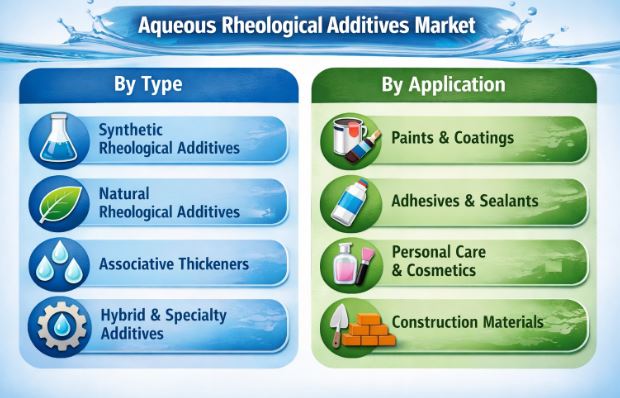
By Type
- Synthetic Rheological Additives
- Natural Rheological Additives
- Associative Thickeners
- Hybrid and Specialty Additives
The Aqueous Rheological Additives Market, by type, is characterized by a diverse mix of chemistries designed to meet specific formulation requirements. Different types of additives provide unique functionalities such as thickening, stabilization, and flow control. This segmentation enables manufacturers to select suitable additives depending on application performance needs and formulation complexity. Advances in polymer science have further enhanced the efficiency and versatility of these types. Additionally, the growing preference for sustainable and bio-based types is reshaping product development strategies. Overall, type-based segmentation plays a crucial role in addressing varied industrial demands.
By Application
- Paints and Coatings
- Adhesives and Sealants
- Personal Care and Cosmetics
- Construction Materials
The Aqueous Rheological Additives Market, by application, reflects its widespread usage across multiple industries requiring precise viscosity and flow management. Applications range from paints and coatings to personal care and construction materials, each demanding specific rheological properties. This segmentation helps in aligning product development with end-use performance expectations and regulatory standards. Increasing demand for high-performance and eco-friendly formulations is further influencing application-specific innovations. Manufacturers focus on enhancing product adaptability across diverse applications. As industries evolve, application-based segmentation continues to drive targeted growth opportunities and specialized solution development.
By End-Use Industry
- Building and Construction
- Automotive and Transportation
- Personal Care Industry
- Packaging Industry
The Aqueous Rheological Additives Market, by end-use industry, highlights the broad industrial reliance on these additives for improved formulation performance. Key industries include construction, automotive, personal care, and packaging, each with distinct functional requirements. This segmentation allows suppliers to tailor additives that meet industry-specific standards and operational conditions. Growing industrialization and changing consumer preferences are driving increased demand across these sectors. Furthermore, the need for sustainable and efficient materials is encouraging innovation within each industry segment. End-use segmentation thus plays a pivotal role in shaping product development and market expansion strategies.
Aqueous Rheological Additives Market REGIONAL INSIGHTS
Here are Key Regional Insights into the Aqueous Rheological Additives Market:
Growing Research is Driving North America – US and Canada Aqueous Rheological Additives Market Trends
The North American aqueous rheological additives market is witnessing significant growth due to increasing research and development activities across multiple industries. Innovation in formulation technologies and sustainable additive solutions is driving product adoption. The focus on environmentally friendly water-based systems is gaining momentum in paints, coatings, and personal care sectors. Additionally, regulatory compliance and technological advancements are encouraging manufacturers to explore new applications. This research-driven growth is positioning North America as a key market for advanced and high-performance aqueous rheological additives.
US Aqueous Rheological Additives Market Trends
The US market is characterized by strong R&D investment aimed at developing eco-friendly and high-efficiency rheological additives. Growing demand from the construction, coatings, and personal care sectors is influencing market expansion. Advanced formulation techniques are being applied to improve viscosity control, stability, and application performance. Sustainability initiatives and stricter environmental regulations are further accelerating the adoption of water-based systems. Innovation in multifunctional additives is helping manufacturers meet diverse industrial requirements. Overall, the US market benefits from a combination of research focus and progressive industrial adoption.
Canada Aqueous Rheological Additives Market Trends
Canada’s aqueous rheological additives market is expanding due to increasing adoption of green formulations and advanced materials. Rising construction activities and the growth of the personal care and coatings industries are driving demand. Companies are focusing on sustainable solutions with enhanced performance properties to meet regulatory standards. Research initiatives in additive efficiency and stability are supporting product innovation. Environmental consciousness among consumers and industrial users is encouraging water-based system adoption. These factors collectively make Canada a promising market for high-performance aqueous rheological additives.
Investment is Driving the Asia Pacific – China and India Aqueous Rheological Additives Market Trends
The Asia Pacific market is experiencing rapid growth driven by significant investment in industrial development, urbanization, and infrastructure projects. Rising demand for paints, coatings, construction materials, and personal care products is fueling adoption of aqueous rheological additives. Investment in research and technology is enabling more efficient and sustainable formulations. The region’s expanding manufacturing base and growing middle-class consumer base are further supporting market growth. This combination of investment and industrial expansion is positioning Asia Pacific as a key growth hub.
China Aqueous Rheological Additives Market Trends
China’s market growth is fueled by large-scale construction and industrial projects, which require high-performance aqueous additives. Increasing adoption of eco-friendly formulations in coatings, adhesives, and personal care products is driving demand. Research into advanced polymeric and multifunctional additives is expanding product offerings. Regulatory compliance and environmental sustainability initiatives are accelerating the shift toward water-based systems. The growing manufacturing sector and rising consumer awareness of sustainable products are also key factors. Overall, China represents a major market opportunity within the Asia Pacific region.
India and Japan Aqueous Rheological Additives Market Trends
India and Japan are witnessing steady growth in aqueous rheological additives due to rising urbanization and industrial development. In India, the booming construction and personal care sectors are driving demand for efficient and sustainable additives. Japan focuses on high-performance formulations and innovation in multifunctional additives for specialized applications. Both countries are emphasizing eco-friendly and regulatory-compliant solutions. Research initiatives and technological investments are enabling manufacturers to meet market expectations. These factors collectively contribute to strong growth potential in India and Japan for aqueous rheological additives.
Top Companies In The Aqueous Rheological Additives Market
Here’s a list of companies operating in the Aqueous Rheological Additives Market with direct links to their official websites:
- BASF SE
- The Dow Chemical Company
- Lubrizol Corporation
- Ashland Global Holdings, Inc.
- CP Kelco
- Elementis plc
- AkzoNobel N.V.
- Tolsa Group
- Croda International Plc
- BYK Additives & Instruments
- Zhejiang Fenghong New Material Co., Ltd.
- Coatex, Inc.
- DuPont
- Evonik Industries AG
- Clariant AG
This list covers key global players known for their involvement in aqueous rheological additives and related formulation solutions.
Recent Key Developments In Aqueous Rheological Additives Market
Here are Recent Major Developments in the Aqueous Rheological Additives Market.
Launch of Advanced High‑Performance Rheological Solutions
Recent developments in the aqueous rheological additives market include the introduction of next‑generation high‑performance rheological solutions tailored for specific end‑use applications. These new products are designed to offer superior viscosity control, improved stability in challenging conditions, and enhanced compatibility with environmentally friendly water‑based systems. The focus has been on multifunctional additives that can deliver better thickening efficiency while reducing overall formulation costs. Many of these advanced solutions also aim to address sustainability goals by incorporating bio‑based components or reducing reliance on fossil‑derived polymers. The development of such cutting‑edge products reflects the industry’s emphasis on innovation and meeting evolving customer demands.
Expansion of Manufacturing Capabilities and Regional Footprint
Another key recent development is the strategic expansion of manufacturing capabilities and increased regional presence to better serve growing markets. Companies in the aqueous rheological additives space have been focusing on scaling up production facilities, optimizing supply chains, and investing in localized infrastructure. This expansion enables faster delivery times, improved inventory management, and reduced logistical challenges in key regions experiencing high demand growth. Investments in manufacturing technology are also helping to enhance quality control and operational efficiency. By strengthening their regional footprint and production capacity, market participants are positioning themselves to respond more effectively to both existing and emerging market opportunities.
Aqueous Rheological Additives Market – FAQ
1. What are aqueous rheological additives?
Aqueous rheological additives are chemical agents used to modify the flow, viscosity, and stability of water-based formulations in industries like paints, coatings, adhesives, and personal care.
2. Which industries use these additives the most?
They are primarily used in paints and coatings, construction materials, adhesives and sealants, personal care products, and various industrial applications requiring viscosity control.
3. What are the main types of aqueous rheological additives?
The main types include cellulosic derivatives, associative thickeners, and inorganic additives, each offering different thickening, stabilizing, and performance-enhancing properties.
4. Why is the market for these additives growing?
Growth is driven by the rising demand for eco-friendly waterborne formulations, stringent environmental regulations, and the need for improved product performance across industries.
